Get the Osprey Farpoint 40: Check price on Amazon (affiliate link)
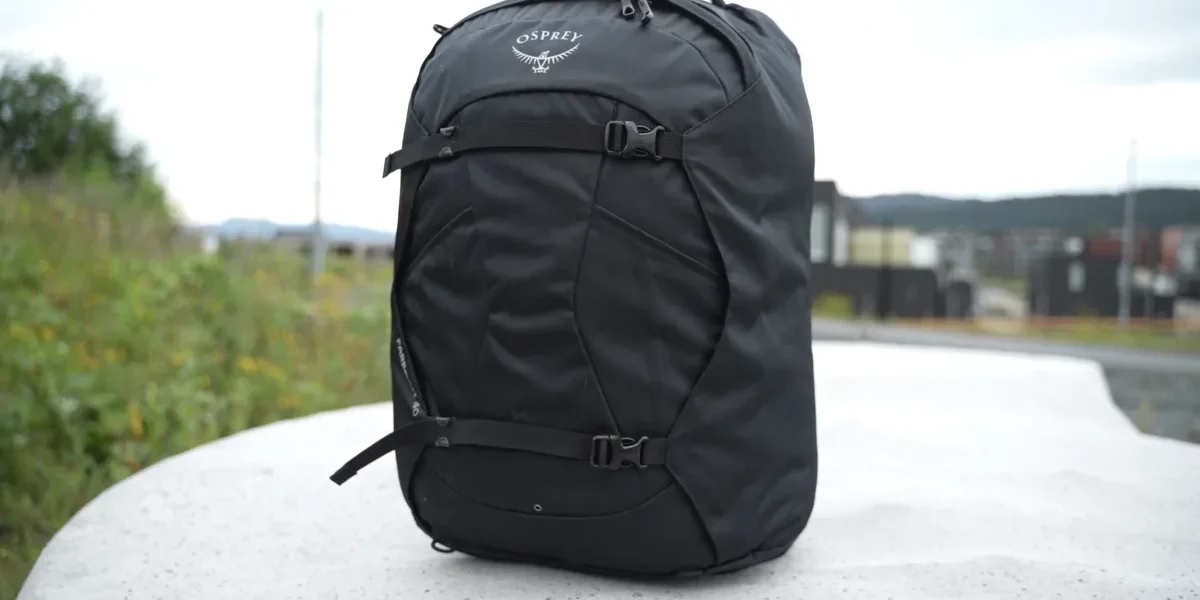
The Osprey Farpoint 40 has been one of the default recommendations for one-bag travel for more than a decade. After a full year of using mine on flights, trains and long walks, I understand why. Its carrying comfort and stowaway harness are excellent. Its pockets are much less convincing.
I published my initial Farpoint 40 review after four weeks. This is the follow-up: what I still appreciate after a year, what still annoys me, and who I think should buy it.
Watch the full one-year review
Specifications and first impressions
The model in this review: I am reviewing my 2022-generation Farpoint 40, with the open front shove-it pocket shown in the video. Osprey has since revised the Farpoint, so the specifications and pocket design here refer to the bag I actually tested.
| Specification | Tested model |
|---|---|
| Capacity | 40 litres |
| Dimensions | Approximately 55 x 35 x 23 cm / 21.7 x 13.8 x 9.1 in |
| Empty weight | Approximately 1.6 kg / 3.5 lb |
| Main fabric | 450D recycled polyester with a PFAS-free water-repellent finish |
| Carrying system | AirScape back panel, adjustable torso length, LightWire frame, padded hip belt, load lifters and sternum strap |
| Laptop compartment | Separate sleeve for a laptop up to 16 inches |
At around 1.6 kg before I put anything inside, this is a fairly heavy bag for something with so little internal organisation. Much of that weight goes into the carrying system. That is also the main reason to choose it.
The Farpoint is intended as a carry-on for the overhead compartment. It is not a universal under-seat personal item, and 40 litres alone does not tell you whether an airline will accept it. Check the size and weight allowance for your airline and ticket, especially if you plan to pack heavily.
Inside: keep it simple, and bring packing cubes
The main compartment opens like a suitcase. Inside, there is a large open space, two compression straps and a zippered mesh pocket in the lid. That is largely it. The separate laptop sleeve is useful, but this is not a bag full of little compartments for every cable and accessory.

I find this layout works best with packing cubes and separate pouches. They give the open compartment some structure and make it easier to find things. If you like a bag that organises everything for you, the Farpoint will feel basic.
On the outside, there is a small zipped top pocket and an open front shove-it pocket with access from either side. The front pocket can take a bottle or a layer of clothing, although it comes with compromises.
The two features that make it work
1. A carrying system that zips away
Loose shoulder straps and a dangling hip belt get in the way when I am moving a backpack around airports, trains or a cafe. The Farpoint has a built-in zippered cover that hides the whole carrying system.
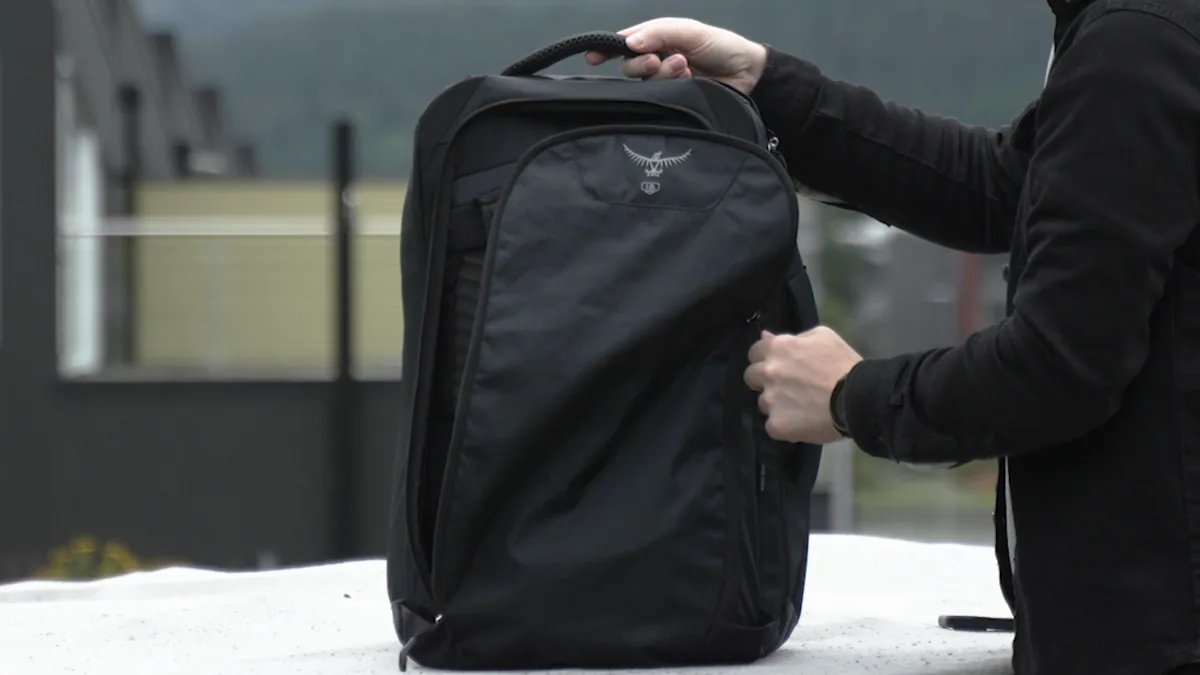
With the straps tucked away, it becomes a much tidier piece of luggage. It is easier to handle and put into an overhead compartment, and there are fewer straps and buckles to catch on things. It is a simple feature that I appreciate every time I use it.
2. Carrying comfort under a heavy load
This is the Farpoint’s strongest feature. The adjustable torso length, padded hip belt, metal frame, load lifters and sternum strap give it a carrying system much closer to a proper hiking backpack than a simple travel bag.
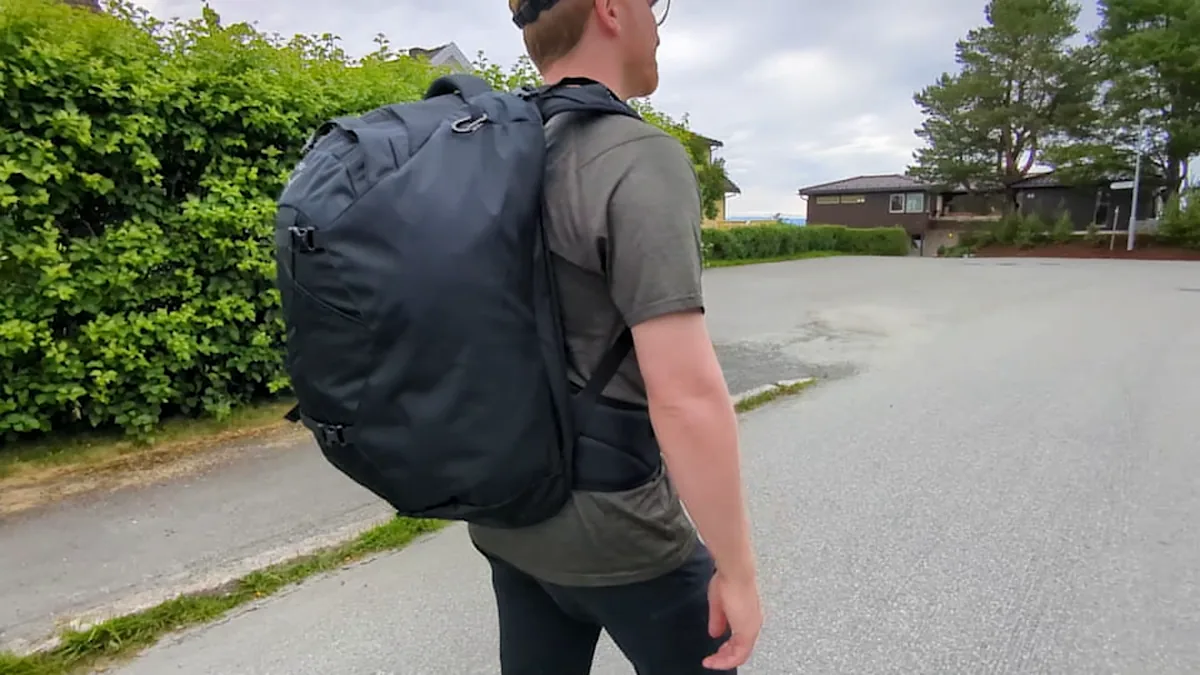
Even with around 12-13 kg inside, I find it remarkably comfortable. Once everything is adjusted, the frame and hip belt help move the weight onto my hips and keep the load close to my body. That makes a real difference when I have a long way to walk with all my luggage.
That is my experience of carrying the bag, not a suggested airline weight allowance. But if your travel involves walking between stations, airports and hotels, this is where the Farpoint earns its extra weight.
What still frustrates me
Limited organisation
There is no dedicated admin panel for pens, charging cables, a passport and other small travel items. The laptop sleeve and mesh pocket help, but I still need pouches to stop smaller things disappearing into the main compartment.
The water-bottle arrangement
The front shove-it pocket is not my favourite bottle solution. When the pack is full, getting a bottle in there is awkward, and the bottle competes with the contents behind it for space. It also does not feel as secure as a dedicated bottle pocket.

The shallow top pocket
The top pocket is useful for keys and small items, but I would like it to be deeper. Together with the front pocket, it leaves the Farpoint short of the convenient, easy-to-access storage I appreciate in other travel bags.
Alternatives worth considering
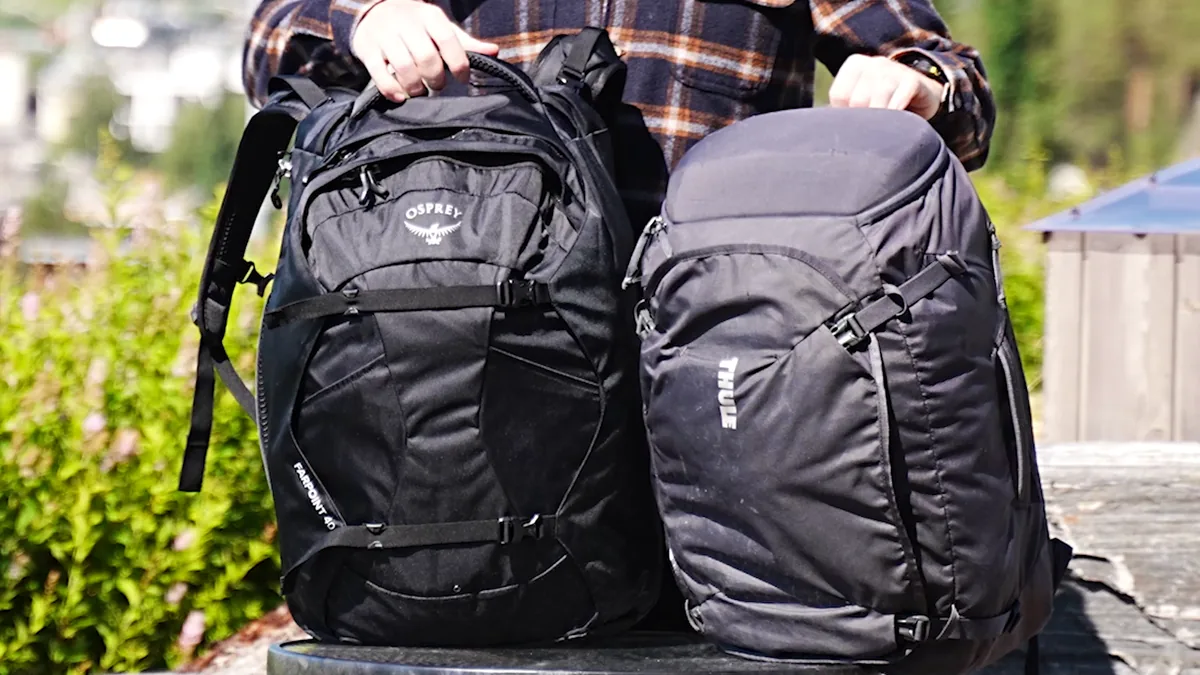
- Osprey Sojourn Porter 30 or 46: worth comparing if organisation and compression matter more to you. The StraightJacket compression system is excellent, but I prefer the Farpoint’s carrying system for heavier loads and longer walks. My Sojourn Porter 30 review covers the smaller version.
- Thule Landmark 40: I prefer parts of its storage layout, especially the top pocket. The Farpoint is the more comfortable option for me under a heavy load. Read my long-term Thule Landmark 40 review for the full comparison.
- Tortuga Travel Backpack Pro 40: another option to compare if you want both a substantial carrying system and more built-in organisation. The alternatives section in the video discusses it alongside the Farpoint.
- Osprey Fairview 40: the corresponding women’s-fit model, with a shorter torso range and a differently shaped harness and hip belt. Fit is the reason to compare these two.
Durability after a year
After a year of use, mine still looks close to new. The fabric, seams and zippers have held up well, with no obvious wear that concerns me. That is reassuring for a bag that gets carried, put down and moved between different forms of transport.
The Farpoint’s appeal becomes clearest when I am actually carrying it. The pockets can be frustrating when I am looking for something small, but the comfort matters more once I am walking with a full pack.
Pros and cons after one year
| What I like | What I would change |
|---|---|
| Excellent carrying comfort with heavier loads | No dedicated admin panel for small items |
| Shoulder straps and hip belt zip away neatly | Awkward water-bottle storage when fully packed |
| Very little visible wear after a year | Relatively heavy at around 1.6 kg empty |
| Large, easy-to-pack main compartment | Packing cubes and pouches are useful for organisation |
| Adjustable fit and effective load transfer | A top pocket that I would like to be deeper |
The verdict: is it still worth the hype?
For the right traveller, yes. I would not choose the Farpoint 40 primarily as a work, school or gym bag. It makes much more sense as a dedicated travel backpack for someone who carries a substantial load and spends a lot of time walking with it.
If you want lots of built-in organisation or the lightest possible bag, there are better matches. But if carrying comfort comes first, the Farpoint remains one of the strongest options I have used. A year later, its two best features are still the ones that matter most to me: a carrying system that handles weight well, and the ability to zip it all out of the way when I need to.
Get the Osprey Farpoint 40: Check price on Amazon (affiliate link)